Is There Hospice In Mexico?
Among the most frequently asked questions that US citizens have about end-of-life care in Mexico is whether or not there is hospice in Mexico.
Yes. There is hospice in Mexico.
And also, not in the way many US citizens imagine it.
In my experience, those moving to Mexico from the United States tend to associate hospice with the Medicare Hospice Benefit, a clearly defined insurance category that requires a physician to certify that a patient has six months or less to live. You may picture hospice as a place you go to, a special room within the hospital or at your assisted living facility. Even if you plan for hospice at home, you may picture an interdisciplinary team arriving at your home, covered by insurance, with morphine in the comfort kit and a nurse on call.
Mexico is different. The philosophy of hospice exists. The legal right to palliative care exists. Access, however, is uneven, making planning even more essential.
About Hospice
Hospice is not a place or any specific service. (A dear neighbor recently described “hospice” to me as terminal sedation - it is not that either). Hospice is care that focuses on comfort, versus curative treatment, at the end of life.
Hospice care differs in this way from palliative care. Palliative care is comfort care that can be provided alongside curative treatment. Palliative care teams address pain and suffering—physical, psychological, social and spiritual—at any stage of serious illness.
In the United States, Medicare will pay for hospice when a doctor certifies that a patient is likely to live six months or less, assuming their illness runs its natural course. Most Americans, however, enroll much later. In 2023, the median time spent in hospice was just 17 days. The reasons are complex.
When surveyed, Americans overwhelmingly say they prioritize pain relief over prolonging life. Yet, their behavior tells a different story. Families and medical professionals continue to pursue treatment, even when it is unlikely to change outcomes.
Part of this disconnect is structural. Under the Medicare Hospice Benefit, patients must switch insurance categories. Physicians must certify a prognosis. Fear of disenrollment, reluctance to predict death, and cultural death denial all contribute to late hospice enrollment.
And yet, those who do enroll in hospice tend to live, on average, nearly a month longer than similarly ill patients who do not. Early hospice often means more quality time, less stress, and greater family satisfaction.
Interestingly, patients with dementia are the least likely to receive hospice or palliative services, despite evidence of benefit. Perhaps because they cannot speak for themselves, or perhaps because the US hospice system was built for more easily-defined disease trajectories, such as lung cancer. As we increasingly die from overlapping chronic illnesses - dementia, COPD, diabetes, heart disease - rather than one predictable illness, systems built on clear, six-month prognoses have struggled to keep up.
This demographic shift is happening in Mexico as well.
Institutional Palliative and Hospice Care in Mexico
In 2009, one year after introducing advance directives, Mexico amended Article 184 of its General Health Law to guarantee quality of life and a dignified death for those with terminal illness. The country’s Consejo de Salubridad General (General Health Council) published a clinician’s guide to improve hospital-based palliative care.
Legally, Mexico recognizes palliative care—and therefore a dignified death—as a human right.
In practice, access remains limited.
In 2014, Human Rights Watch published a report describing Mexico’s access to palliative care and pain treatment as “very limited.” Pain medication, particularly opioids such as morphine, was described as excessively regulated. Many physicians had received no formal palliative care training. At that time, only a small fraction of Mexico’s medical schools required such instruction.
Availability remains uneven. In 2023, Mexico had fewer than one palliative care team per million inhabitants—well below the Latin American average. Opioid access continues to be scarce and unevenly distributed, with wealthier states having significantly greater access than poorer ones.
What does this mean in practical terms?
If you are relying on the public healthcare system for end-of-life comfort care, comprehensive palliative care services may not be available in your area. Pain clinics and hospice units are typically concentrated in large urban hospitals.
Private hospice homes do exist, primarily in major cities. If you plan to age in a private assisted living facility, it is wise to ask:
Are staff trained specifically in palliative or hospice care?
Is there a physician on site who can prescribe pain medication?
What happens if my needs exceed what you can provide?
In the United States, morphine, for example, is frequently used in hospice care to relieve both pain and shortness of breath. The World Health Organization considers palliative care essential and recommends that countries ensure access to medications like morphine.
In Mexico, you may not have ready access to such medications outside of major private hospitals.
And yet, access to opioids does not define hospice, nor may it be necessary at all at the end of life.
Pain and Comfort Care at End of Life
The late hospice pioneer Cicely Saunders introduced the concept of ‘Total Pain.’ Pain is not purely physical. It includes psychological, social and spiritual suffering.
These domains are interconnected. When we improve one, we influence the others. Improving these domains is something we can begin now, regardless of our age or health.
When US Citizens ask me if there’s hospice in Mexico, and I dig deeper, I typically find that what they’re really asking is, will I have access to pain medications at the end of my life?
As immigrants to Mexico from the US, we come from a culture that has little-to-no first-hand experience with what it’s like to die a natural death. Our idea of what death looks like - namely, suffering - comes from stories, movies and the uninformed. You might be surprised to hear that while some deaths can be physically painful, many (if not most) deaths are not.
“Pain,” how it’s defined and how it is experienced, is also influenced by culture. In Mexico, where death often takes place in the home and is far less medicalized than in the US, death stories differ. So too, does the experience of pain.
Even where medical resources are limited, suffering can be reduced through:
Clear communication
The presence of family and friends
Emotional support
Meaning-making
Spiritual care
Acceptance
Being cared for at end of life by community members with an intact memory of having cared for the dying is a form of comfort care. In Mexico, institutional hospice care is rare, in part, because most people die at home.
As an immigrant to Mexico from the US, you may not have close family nearby, but perhaps dying at home or outside of the hospital is a form of comfort care for you.
By planning ahead, you can arrange for end-of-life hospice care at home in Mexico.
Home-Based Hospice in Mexico
Hospice and palliative care are approaches to care, not places. They can occur in hospitals, residential facilities or at home.
Choosing home (versus institutional) hospice does not shorten life. In many cases, people who receive hospice at home live longer than those who remain in hospitals at the end of life.
In the United States, families who choose to hospice at home often face what is called the “hospice gap.” Under the Medicare Hospice Benefit, a hospice nurse may visit once or twice weekly for about an hour. Families fill the remaining hours.
In Mexico, if you plan for a home death, you must plan for your own hospice “gap.”
Medical Support at Home
In larger Mexican cities, private home care agencies increasingly offer hospice-style nursing: monitoring symptoms, administering medications, treating pressure wounds and coordinating care.
In rural areas, professional home hospice services may not exist.
That does not prohibit dying at home. It simply requires realistic planning.
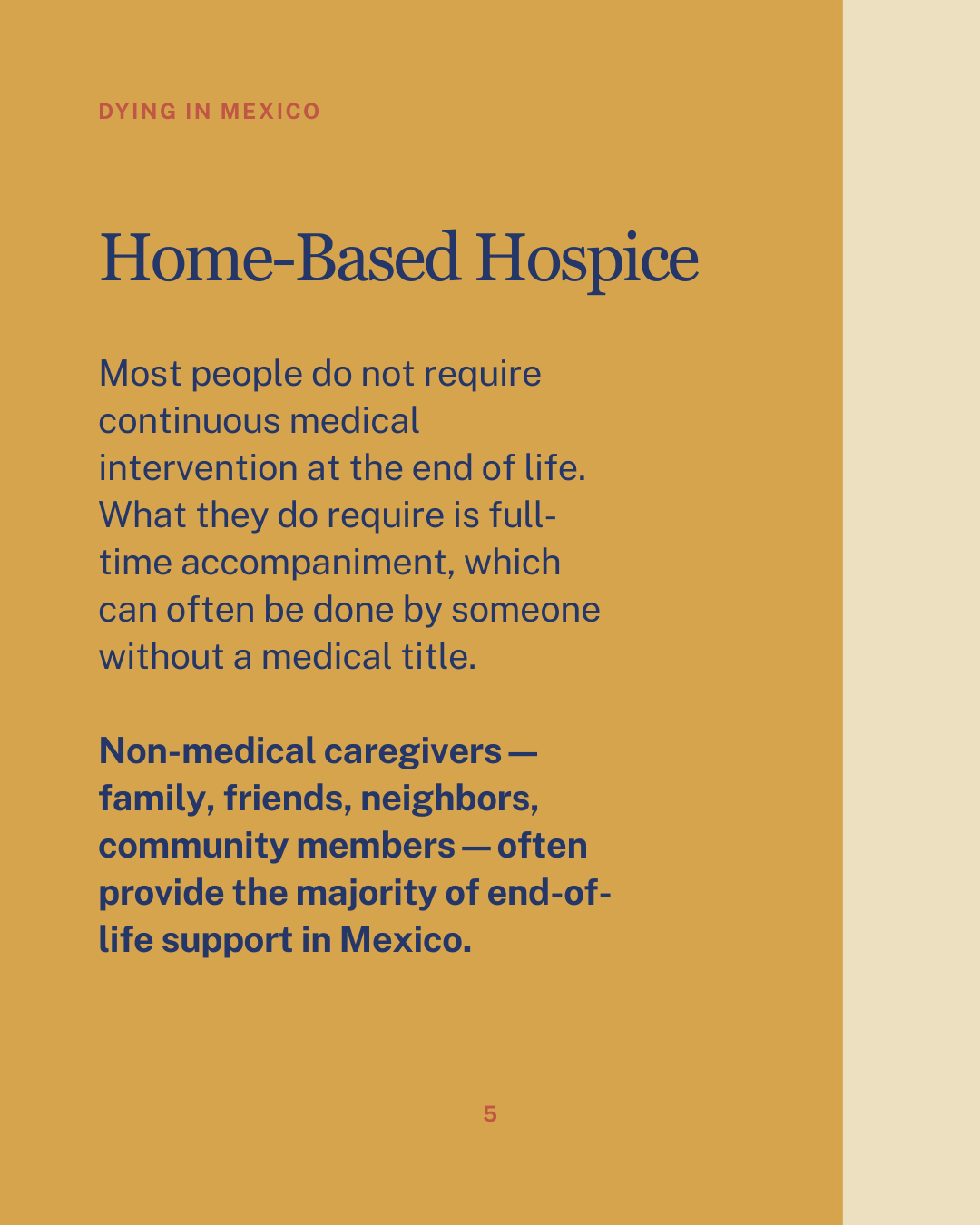
Most people do not require continuous medical intervention at the end of life. What they do require is full-time accompaniment, which can often be done by someone with little to no medical experience.
Non-Medical Hospice Care in Mexico
Non-medical caregivers—family, friends, neighbors, community members—often provide the majority of end-of-life support in Mexico.
Where death has historically occurred within the home, many Mexican caregivers, even those without formal training, have firsthand experience accompanying others through death.
In some regions of Mexico, you may find a death doula (sometimes called doula de la muerte or matrona de muerte). A death doula is not medically trained but can offer emotional, spiritual and practical support before, during and after death.
Even when formal hospice or professional nursing care is limited, skilled, experienced and compassionate home hospice care is available.
What You Need to Know Before Hosting Hospice at Home
If you or your loved one plans to die at home in Mexico, preparation is key.
Whoever is providing care—family member, friend or hired caregiver—should understand:
Common symptoms
The expected trajectory of the illness
When to call a medical provider
How to assess pain
Non-medical comfort measures
Signs of active dying
What to do after death occurs
Speak openly with potential home care providers. Ask what you will be expected to manage on your own. Clarify who is available for questions. Plan for respite care. Know who will step in if the primary caregiver becomes exhausted.
Prepare the physical space. A clean, uncluttered room. Access to fresh air and nature. Soothing sounds. Meaningful objects. Familiar people.
Ideally, these conversations happen early, as you’re planning advance directives and within broader death planing discussions. At the center the of every decision should be the dying person and their wishes.
Caring for the Caregiver
If you plan to care for someone at home, your well-being matters, too.
It is common to want to give everything. To place all attention on the dying person. To feel guilt when resting.
Exhausted caregivers suffer, however, and quickly become less effective helpers.
True self-care is not escape. It is the cultivation of internal resources.
Simple practices can help regulate your nervous system and build resilience:
Stay in bed five extra minutes in the morning.
Begin your day without immediately reaching for your phone.
Walk outside regularly.
Meditate for ten minutes daily.
Set “do not disturb” hours in the evening.
End screen time one hour before sleep.
Reflect nightly on three things you are grateful for.
Community is equally important. Invite others into the process. Accept help. Cultivate your friendships in Mexico now, especially with those who live close to you. Building community as an immigrant to Mexico may require intention and vulnerability, but it is invaluable for quality of life.
So, Is There Hospice in Mexico?
Yes, there is hospice in Mexico.
Mexico legally recognizes the right to palliative care and a dignified death. Private hospice homes and services exist, although they’re likely to be found in major cities. Home-based care, both medical and non-medical, is increasingly available.
If you want a peaceful, easeful death in Mexico, it helps to plan. Planning for hospice (at a facility or at home) means the following…
Clarifying what quality of life means to you.
Documenting when you would want to shift from curative to comfort care.
Researching available hospice services in your region of Mexico.
Preparing for the hospice gap (whether in an institution or at home).
Building community.
A gentle death is not created in the final week of life. It is shaped by how we live, how we communicate, how we prepare and how we support one another, long before the diagnosis.
Hospice in Mexico may not look like hospice in the United States, but comfort, dignity and skilled, compassionate accompaniment are certainly possible if we plan ahead.
Read more articles on living with assistance in Mexico…
When diagnosed with a life-limiting illness, we may react with an urgent desire to move to another country. This is perfectly normal. We may want to get …