What to Do When Someone Dies in Mexico
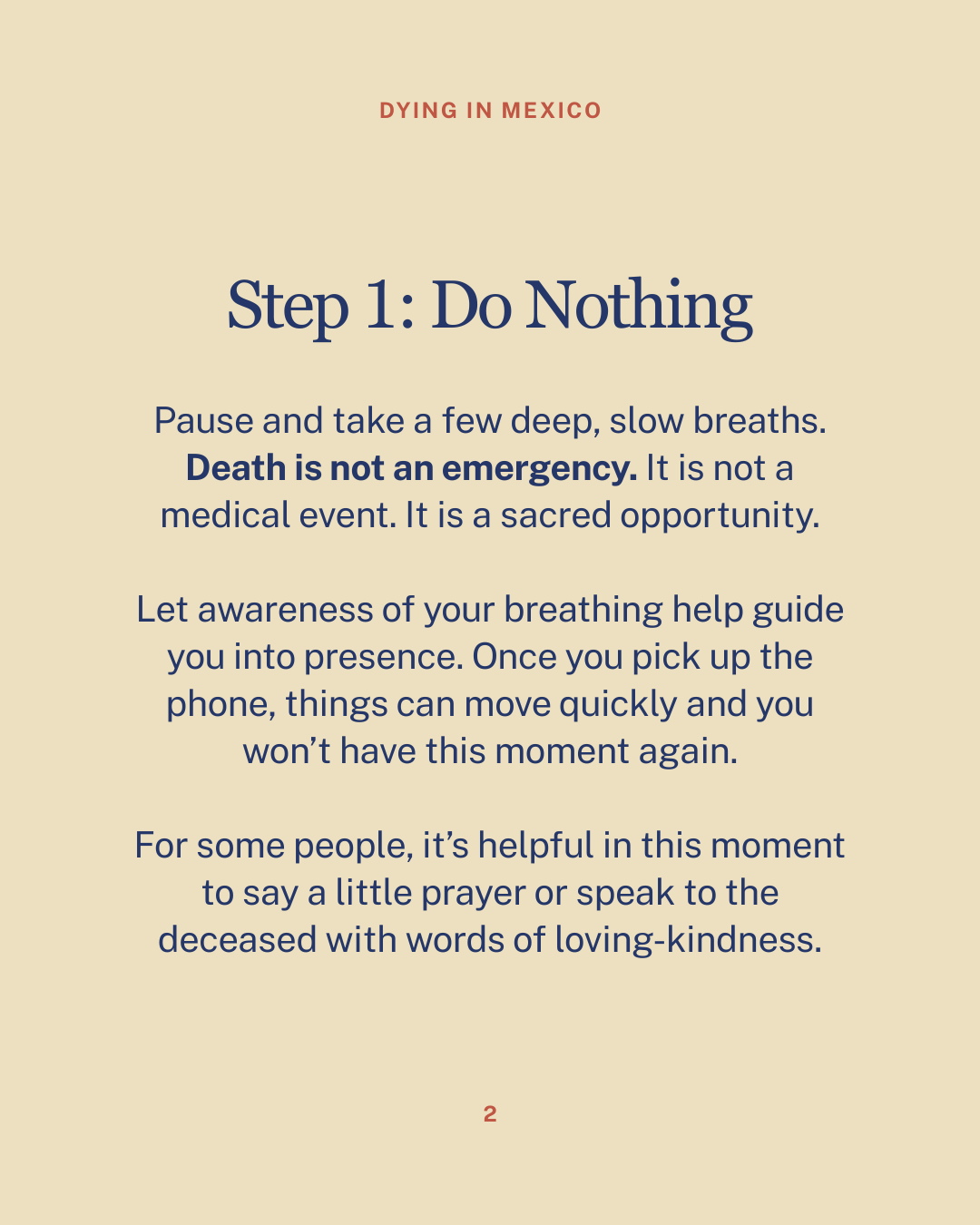
When someone dies naturally at home in Mexico, the first thing to do is nothing.
Sit and be still with the body. Take three slow, deep breaths and allow yourself to be present with the moment. Death is not only a logistical event—it is also a sacred one.
Take your time. Once you notify the authorities, things can start to move quickly. You may find yourself navigating paperwork, coordinating with officials, and deeply engaged with Mexican bureaucracy. It may be several days before you have another opportunity for quiet reflection.
Breathe.
Ready to move on?
This guide explains what to do when a US citizen dies a natural death in Mexico, how the process works, and what paperwork and authorities may be involved.
In brief, the steps are as follows…
Know who to call first - this varies depending on region
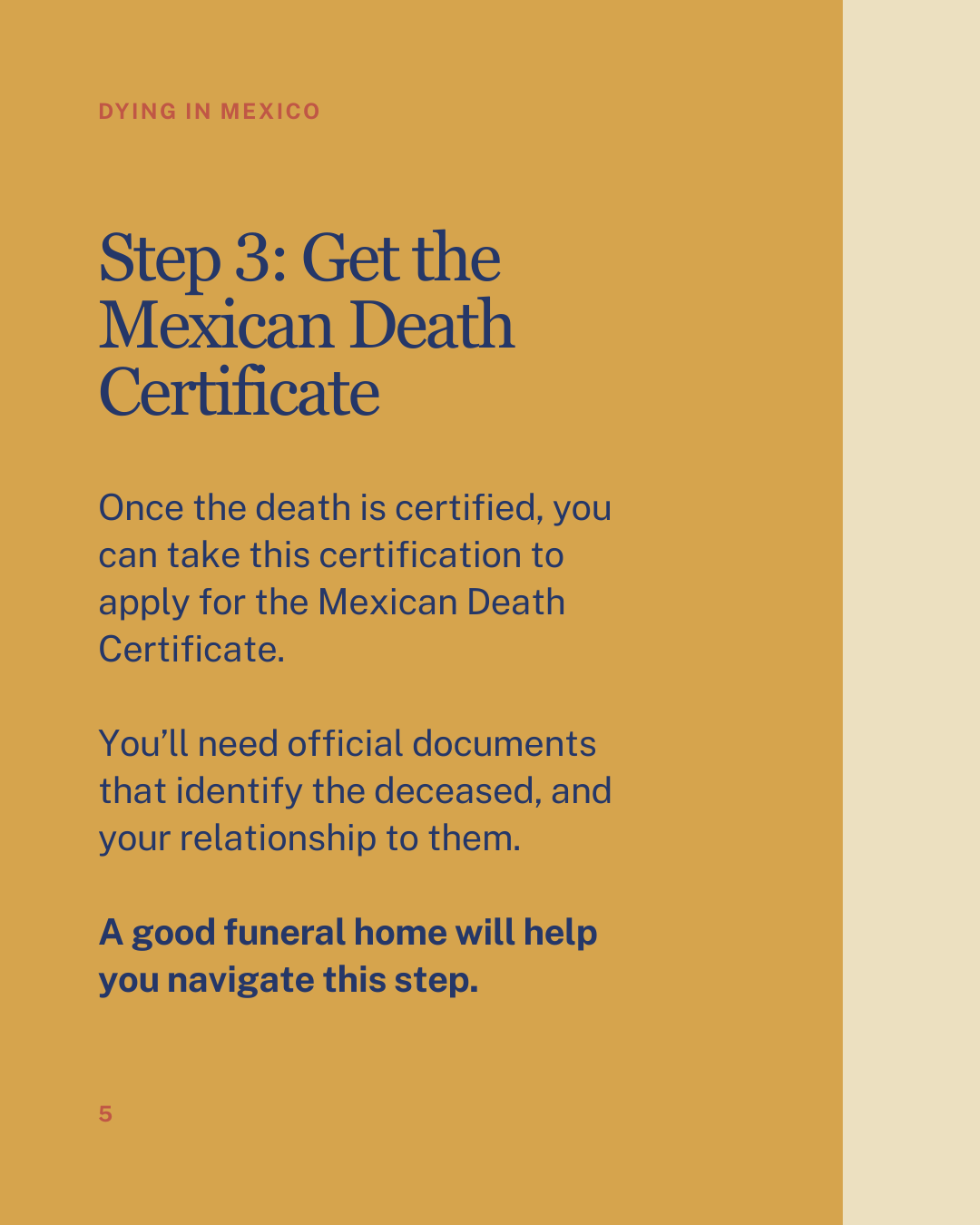
Get the Mexican death certificate
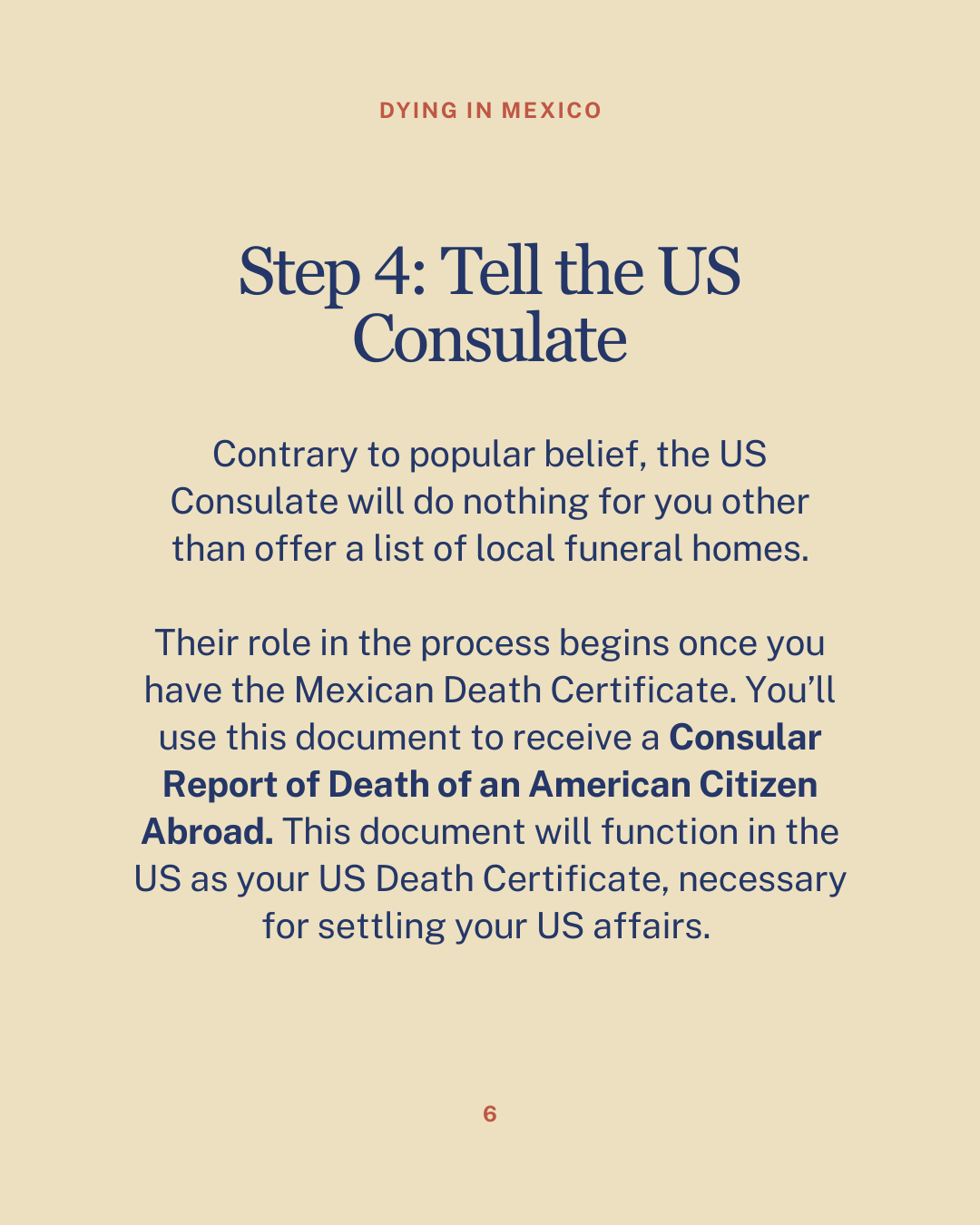
Notify the US consulate for the ‘US death certificate’
For more detail, and to learn what you can do now to make this process easier at the time of death, keep reading.
Know Who to Call First
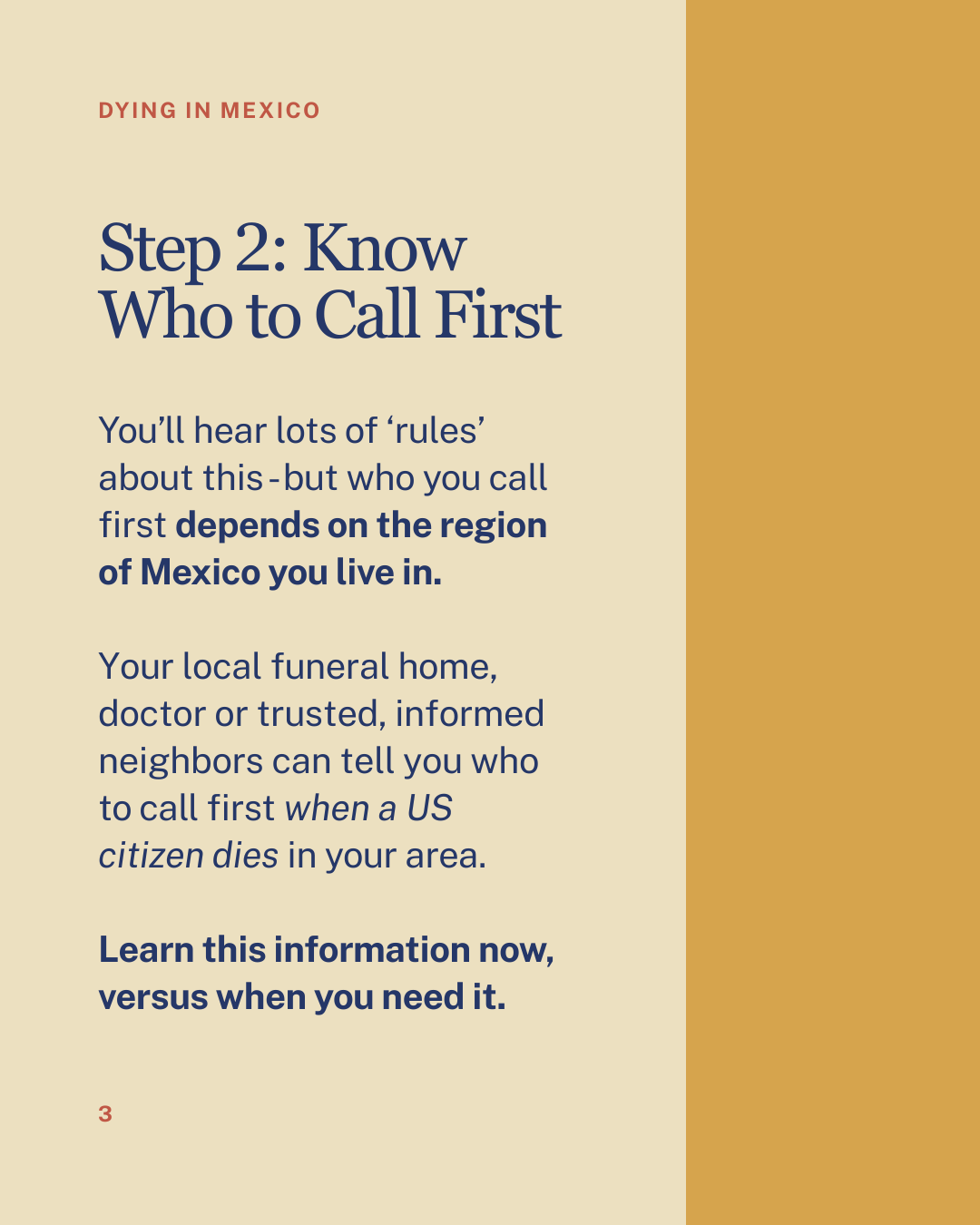
Knowing who to call first when someone dies a natural death in Mexico is perhaps the most important thing to know.
Who to call first will vary depending on the region of Mexico you’re in, so it’s wise to confirm with the locals. Ask your neighbors, your doctor, or your funeral home what to do.
Depending on where you live, you’ll likely to be advised to call one of the following…
The deceased’s physician
Any physician who can certify the death
The deceased’s funeral home
Local police, firefighters or 911
When considering who to call first, note that the situation can be different for foreign residents, particularly for US citizens.
When a US citizen dies in Mexico, the US consulate generally requires that the death be reviewed by local authorities and documented appropriately. In some regions, this means an autopsy is required.
In practice, the meaning of “autopsy” in Mexico differs from what you’d expect if you heard this word in the US. In many cases, the autopsy is nothing more than a visual confirmation by a forensic doctor that death occurred due to natural causes, illness, or advanced age.
There are many reasons why US citizens who die in Mexico would prefer to avoid the autopsy, especially when that procedure must take place at the local morgue—known as SEMEFO (Servicio Médico Forense).
An autopsy takes time, it can lead to additional expenses, and in some cases, authorities may limit access to the place of death until SEMEFO officials certify the death as natural.
Note that the aforementioned are not automatic outcomes, and in some regions of Mexico, there is no means via which a US citizen can avoid being taken to SEMEFO for an autopsy upon death.
It is important to understand the preferred steps to follow in your specific region of Mexico. By planning ahead, you’ll know exactly who to call when someone dies, thus preventing unnecessary delays or complications.
Why, In Some Regions, Calling 911 Is Not Advised
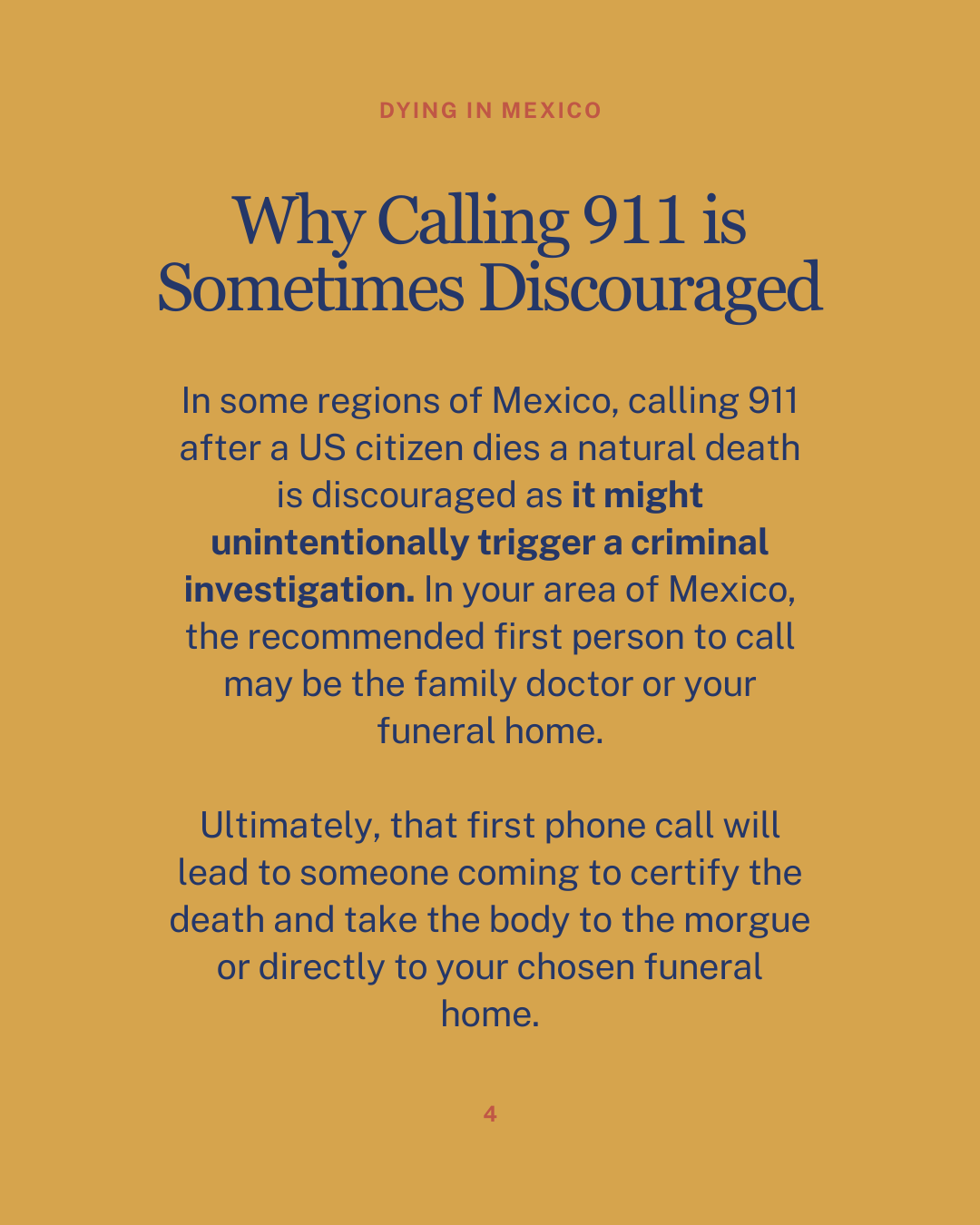
In some regions of Mexico, calling emergency first responders after a natural death can unintentionally trigger a criminal investigation.
Because the cause of death has not yet been determined, authorities may temporarily treat the home as a potential crime scene. This can lead to the body being transferred to SEMEFO for an autopsy.
This process can involve additional paperwork and sometimes additional costs for:
Autopsy services
Body storage
Embalming
That said, there are regions of Mexico—particularly in smaller towns—where calling emergency first responders is exactly the right thing to do. Know what the recommended first phone call is where you live.
When To Call a Doctor or Funeral Home
In areas where calling emergency services is discouraged, contacting a doctor or funeral home first helps avoid a forensic investigation.
In some areas of Mexico, a family physician can certify the death and issue the certificado de defunción, allowing funeral arrangements to proceed.
It’s understandable that doctors can be hesitant to certify the death of someone they have never treated. For this reason, it is wise to establish a relationship with a local physician prior to death.
If you have purchased a pre-need plan with a funeral home, they will usually provide clear instructions about who to call when death occurs. Often, the funeral home will ask that you contact them first so they can coordinate the process and ensure the appropriate authority certifies the death.
2. Obtain the Official Mexican Death Certificate
Once the death has been certified by the appropriate official, you will receive the certificado de defunción, otherwise known as thepreliminary death certificate. Review it carefully. Even small errors, such as inconsistent spelling of names, can cause problems later.
The certificado de defunción is not the final death certificate.
To proceed with burial, cremation, or estate matters, the family must obtain the official death certificate known as the acta de defunción.
This document is issued by the Registro Civil (Civil Registry) and functions much like a death certificate in the United States.
To request it, the next-of-kin typically must present:
The original certificado de defunción, signed by a medical professional
Official photo identification of the next-of-kin or legal representative
Proof of relationship to the deceased (such as an apostilled marriage certificate or birth certificate)
The deceased’s birth certificate or passport
Proof of the deceased’s address (such as a utility bill)
Occasionally, a copy of the deceased’s will
Note that if you have a pre-need funeral plan, your funeral home will typically have you gather these documents in advance (and they’ll help you with this process), so you won’t be scrambling at the worst possible hour.
While some regions of Mexico allow death certificates to be requested online, foreigners are often required to complete this process in person due to additional identification requirements.
Check the final acta de defunción carefully for errors, especially name spellings. If the surviving spouse’s name appears on the certificate, it should match their identification exactly.
Many lawyers recommend requesting multiple official copies of the death certificate, sometimes as many as seven, since they may be required for estate administration both in Mexico and the United States.
3. Notify the Necessary Additional Authorities
If the deceased was a US citizen living in Mexico, two additional authorities must be notified, the US Consulate and Mexican immigration.
The US Consulate
The nearest US consulate must be informed so they can prepare a Consular Report of Death of an American Citizen Abroad. This report functions as your ‘US death certificate.’
To obtain this report, the consulate usually requires:
An original copy of the Mexican acta de defunción
Proof of US citizenship (passport or birth certificate)
The deceased’s Social Security number
Identification and contact information for next-of-kin
Evidence of the relationship to the deceased
This report allows the death to be legally recognized in the United States and can be used in US courts when settling estate matters.
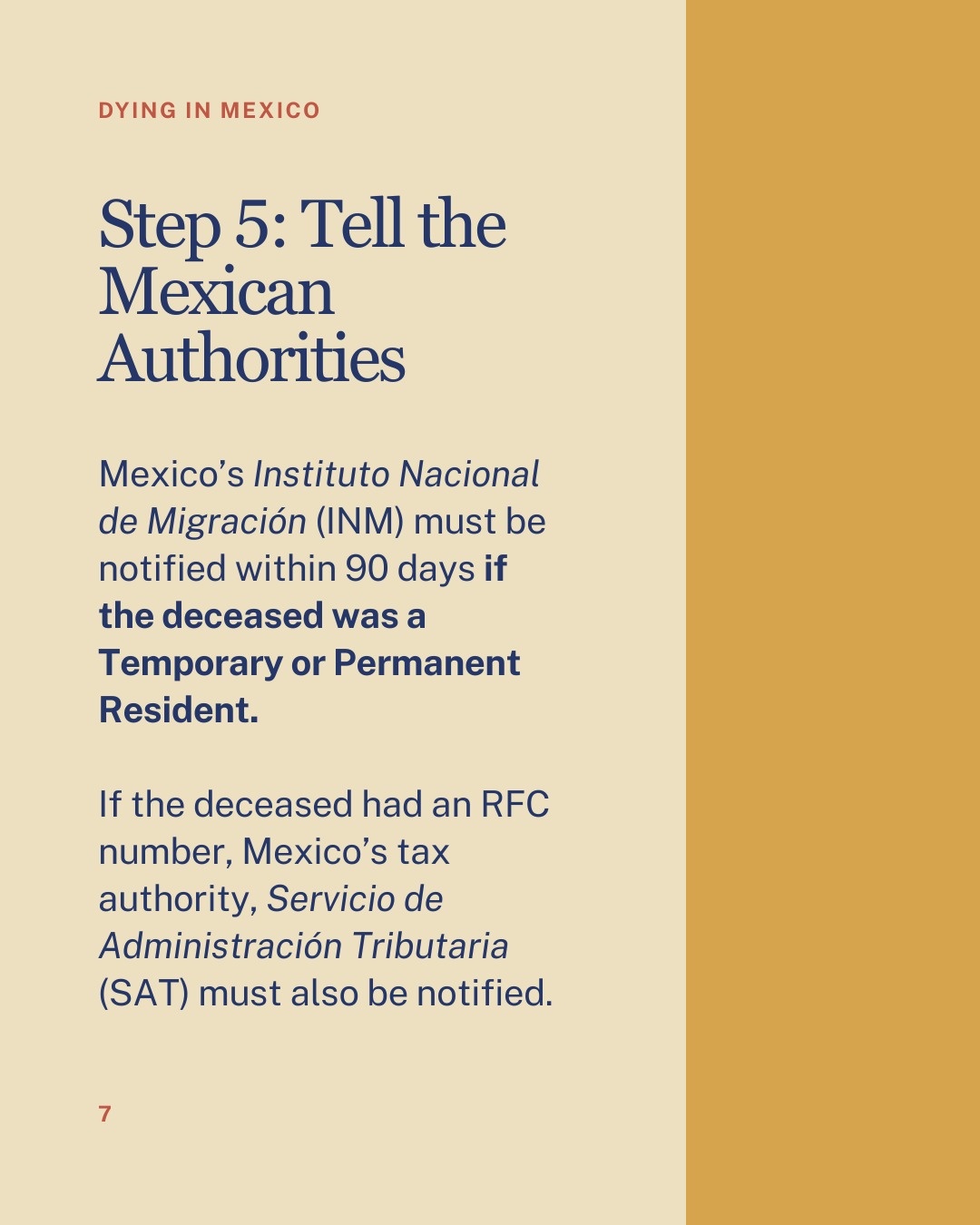
Mexican Immigration (INM)
If the deceased held temporary or permanent residency in Mexico, the Instituto Nacional de Migración (INM) must also be notified.
Surviving spouses typically have 90 days to report the death and update their marital status.
If the deceased was registered with Mexico’s tax authority, Servicio de Administración Tributaria (SAT), they may also need to be notified so the deceased’s RFC number can be canceled.
The Role of Funeral Homes in Mexico
Funeral homes in Mexico can help coordinate many of these steps, including:
Removing the body from the home
Assisting with death certificates
Coordinating repatriation of remains to the United States
Establishing a relationship with a funeral home in advance can simplify the process considerably.
Many funeral homes offer pre-need plans, which allow individuals to pay for funeral expenses ahead of time. These plans not only allow you to lock in current pricing, but relieve next-of-kin of the burden of making decisions and scrambling for paperwork during a time of grief.
Note that pre-need contracts are different from insurance policies, many of which require ongoing monthly payments until death.
Learn more about the role of funeral homes in Mexico, and why pre-planning matters, by watching the video below.
Returning Remains to the United States
If someone wishes to have their body or cremated remains returned to the United States, this process must be coordinated through funeral homes in both Mexico and the US. Because this process involves international transportation and documentation, it is almost always handled by professionals.
The Mexican funeral home prepares the remains and handles export documentation, while (in the case of repatriating a body) the US funeral home receives the body and manages final arrangements.
Repatriating a body can be very expensive. If this is important to you, consider pre-planning and purchasing ‘repatriation of remains’ insurance from a reputable provider.
Planning Ahead Can Ease the Burden
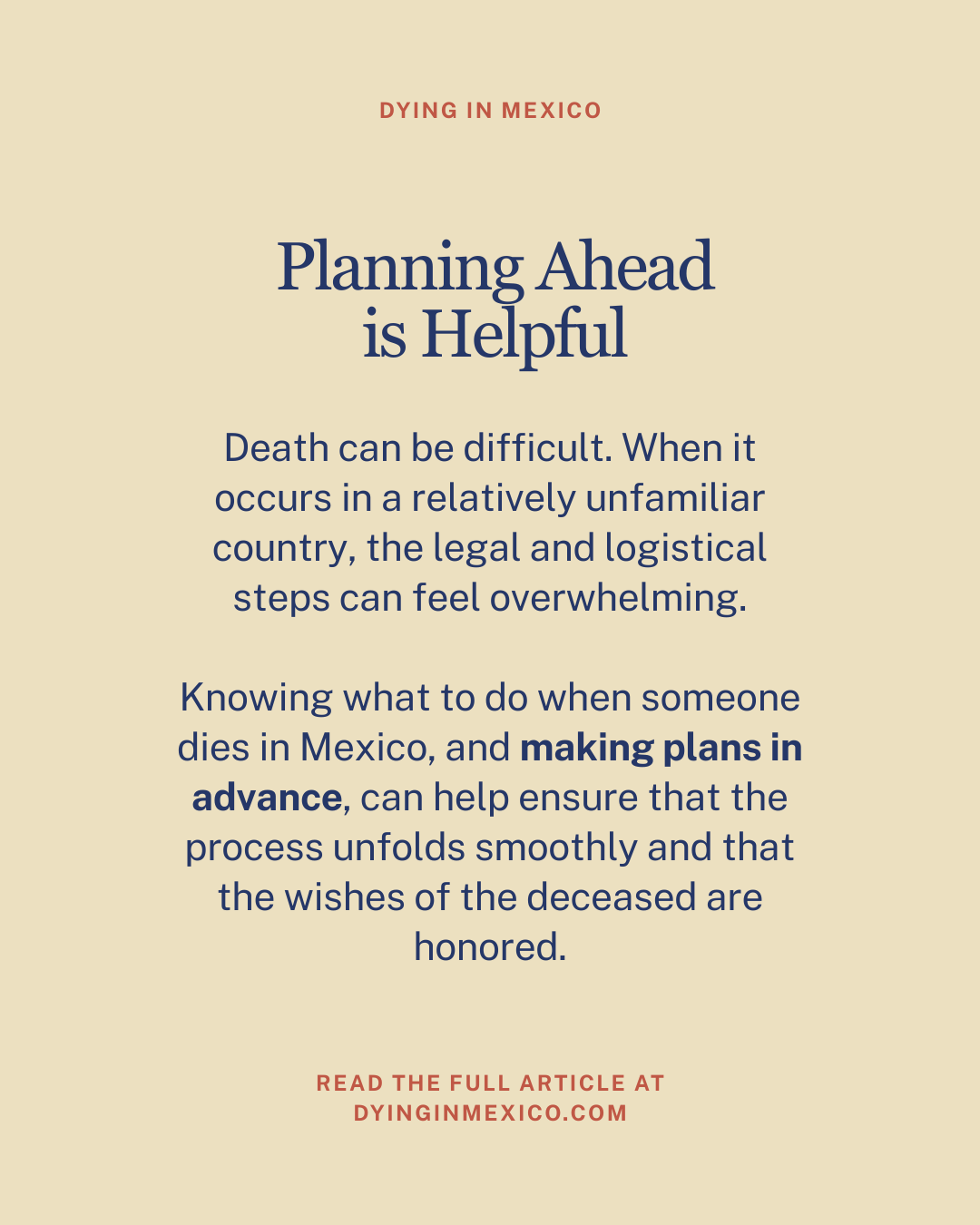
Death can be difficult. When it occurs in a relatively unfamiliar country, the legal and logistical steps can feel overwhelming.
Knowing what to do when someone dies in Mexico—and making plans in advance—can help ensure that the process unfolds smoothly and that the wishes of the deceased are honored.
Just as importantly, it allows families to spend less time navigating bureaucracy and more time focusing on what truly matters as they grieve.