I’m Dying: Is It Too Late To Move To Mexico?
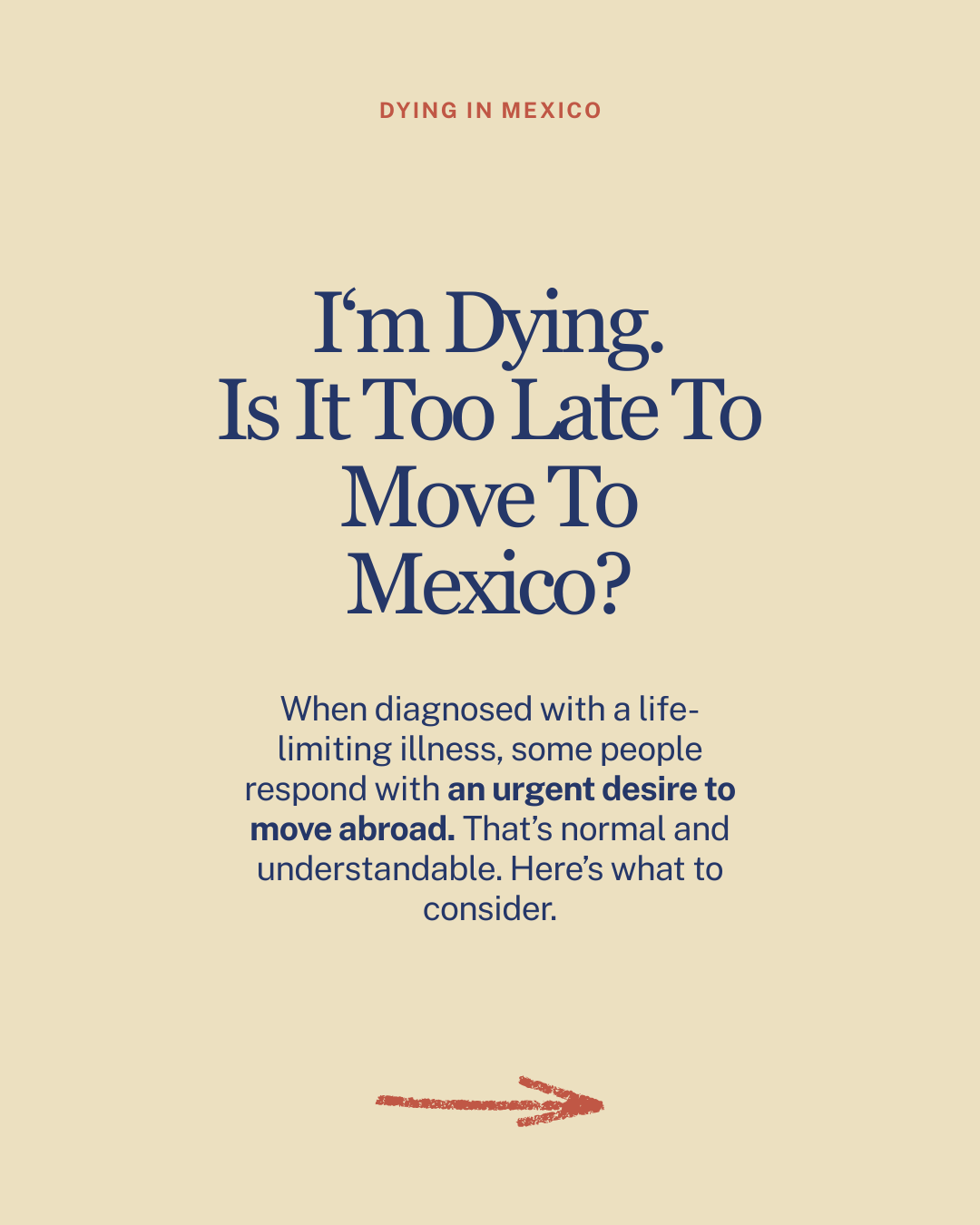
When diagnosed with a life-limiting illness, we may react with an urgent desire to move to another country. This is perfectly normal. We may want to get away, fulfill our dreams, relive a childhood memory, find alternative or more accessible care, or spend our last days in a room with an ocean view. The reasons we have for wanting to move are as diverse as we are.
Since founding the Dying In Mexico project, I’ve received several inquiries from people still living in the US, asking about hospice on the coast of Mexico. There is no wonder why it’s a common question; spending the last few months of life in Mexico sounds lovely.
Whether this is a possibility for any one individual, however, depends entirely on that person and their unique circumstances. Below are six points to consider if you’re wondering whether it’s too late to move to Mexico after being diagnosed with a serious illness.

Can You Legally Move To Mexico?
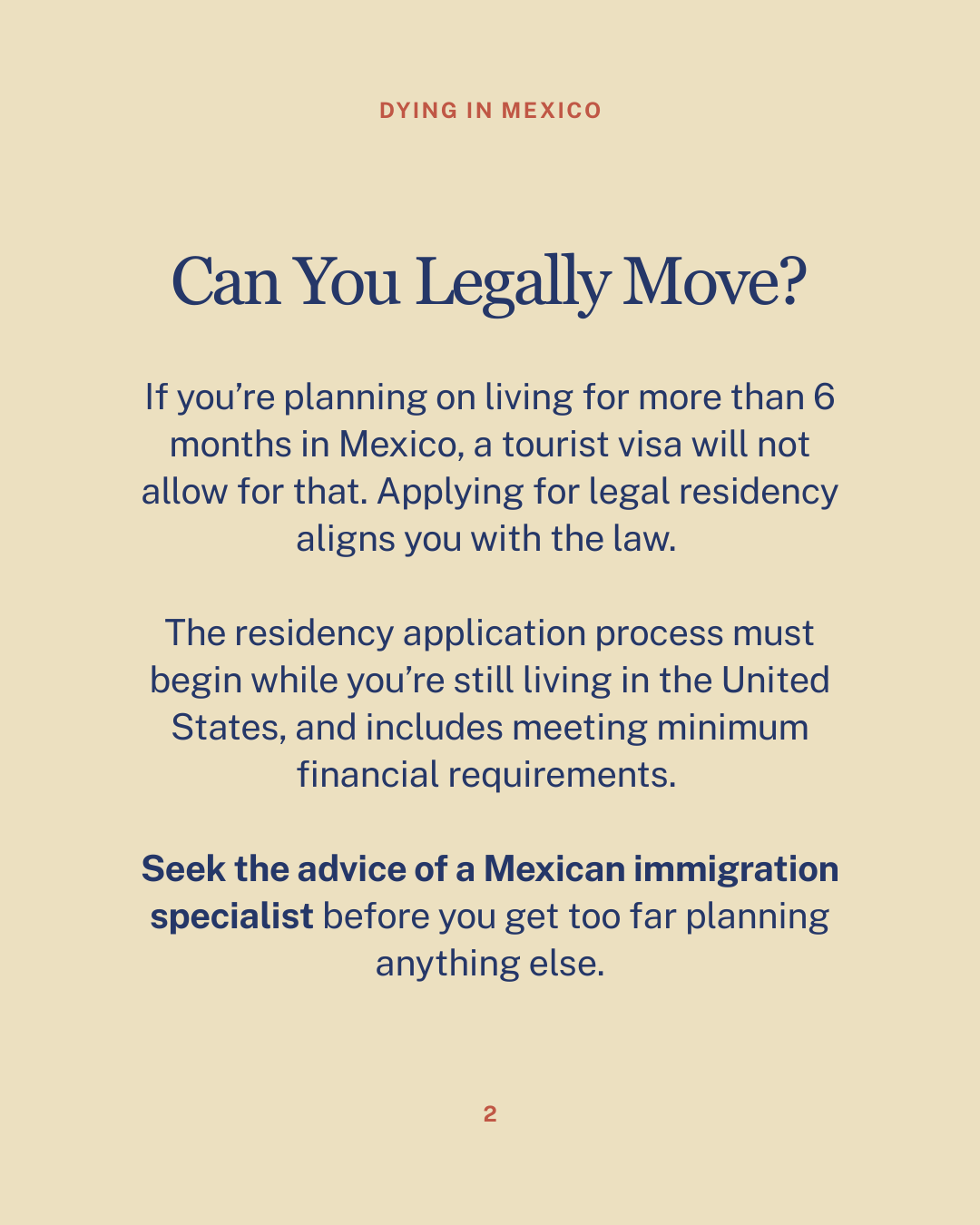
If you’re planning on dying in Mexico, among the first questions to ask yourself is whether you might live for longer than the 180-day tourist visa allows. That’s roughly 6 months.
In the United States, a person qualifies for ‘hospice’ when doctors agree it is unlikely they will live for longer than 6 months. That 6-month time frame, however, has more to do with your US health insurance policy than any absolute truth about when one ‘should’ enter into hospice.
According to the strict definition of the word, you’re on ‘hospice’ once you have chosen to forego curative treatment and focus instead on comfort care. How long you will live once you have made that choice can be hard to predict.
If you’re planning a longer life in Mexico, applying for legal residency aligns you with the law. The application process must begin while you’re still living in the United States, and includes meeting minimum financial requirements. Seek the advice of a Mexican immigration specialist before you get too far planning anything else.
2. What Type Of Health Care Do You Expect?
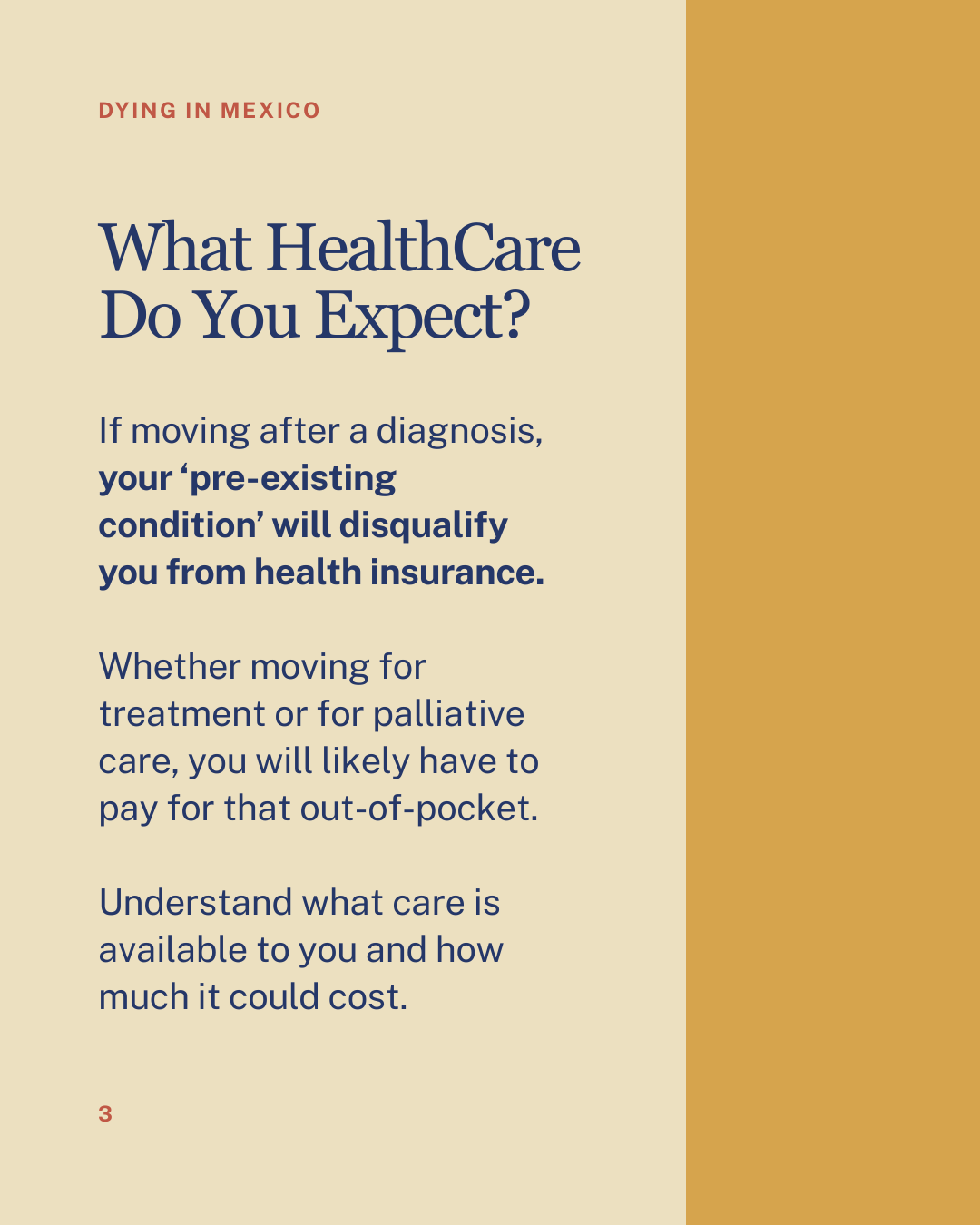
If you’re not yet ready to give up curative treatments, but considering a post-diagnosis move to Mexico, know that you now have a ‘pre-existing condition’ that will most likely disqualify you from health insurance, or at the least, disqualify you from having anything related to that particular condition covered.
If you intend to move to Mexico for medical care after receiving a diagnosis, it may be that you’ll have to pay for that care out of pocket, including palliative or hospice care.
What type of care do you hope for at the end of life? In the United States, ‘hospice’ may be packaged as a hospital stay with a steady drip of morphine, a hospice home with 24/7 care, a nurse who visits you at your home for 2 hours each week, a rotation of family members sitting vigil by your bedside, or some combination of the above.
Before making a move, clarify what you would personally expect for end-of-life care. Is your vision possible in Mexico, and without insurance, could you afford it?
3. Where Will You Live?
In Mexico, hospice is less likely to take place in an institution, and more likely to take place at home. Assisted living exists in Mexico, and those facilities care for hospice patients. Even in a care facility, however, you may be responsible for managing visits from a comfort care provider. Would you like someone to massage your feet or keep a cool towel on your head in the final moments of your life? You may have to schedule (and pay for) that as an extra.
Assisted living facilities in Mexico also tend to be smaller than those in the US and may have limited space. If you hope to move shortly, your top choice may be unavailable. If the alternative is renting an apartment and hiring help at home, there’s much to consider. How long would it take to find the perfect place? Is it furnished and appropriate for home hospice? Would you qualify to rent it? Who would provide you with meals or medications? How would you connect to a local doctor? Who is managing your care, and caring for you, daily?
In the video below, Senior Living Consultant Samantha Elliott discusses the role of a private care coordinator in Mexico, and why having an English-speaking professional managing your care (at home or in a facility) can be helpful.
4. How Do You Want To Spend Your Days?
If, as you’re reading, Mexico still sounds like a ‘yes,’ consider the logistics of the move and how you would physically get from where you live now to where you’d like to be. Moving, even within the same city, requires spending time, money, and energy. That spend can multiply when we move to a new country. The most obvious question becomes, how do you want to spend your remaining days?
You might calculate the expense of the move and the time you could have in Mexico and decide it’s worth it. You possibly have a team of loved ones ready to jump in and handle all the logistics for you. As you decide, be truthful with yourself about the challenges of moving and how resourced you currently feel.
Moving aside, how do you spend your days now, and what will your days look like in Mexico? What are some things you enjoy doing, who do you enjoy spending time with, and how might that change in a new and potentially unfamiliar place?
5. Where Is Your Circle Of Support?
As we approach death, we increasingly rely on others for mental, emotional, and physical support. Who is in your circle of support and where are they located now? Will their support become more or less available if you move to Mexico? Consider how moving to Mexico will impact your access to helpers.
Do you have friends or family already living in Mexico or planning to move with you? Do you plan to rely entirely on the staff of an assisted living facility, who may speak limited English? Do you plan to hire English-speaking caregivers and companions?
People who move to Mexico from the US often describe it as a warmer and more caring culture. If you have limited time to integrate, however, it helps to be intentional about how we plan to connect to that community of care. It may be that we pay for the support we need. That’s not wrong or bad, but something to consider.
In the video below, relocation specialists Cat & Coco discuss what it was like to move to Mexico with their aging parents, and how they rely on a combination of familial and paid caregivers.
6. What’s Behind Your Desire?
A lot can arise after being diagnosed with an illness in an advanced stage of progression. While some people might shut down, others mobilize to start checking items off their bucket list. You may feel driven to seek out closeness or solitude, quiet comfort or adventurous sensorial experience, all of the above, and everything in between. There’s no right or wrong response, and plans or wishes can change from day to day as we work through grief and wrestle with acceptance.
If you’re visualizing spending your last days in Mexican, be still for a moment and further explore that vision. What is the feeling that being in Mexico might address? What is the desire underneath the desire?
Is there a certain view, temperature, smell, or taste you long for? Does this vision of Mexico evoke a memory, something you wish to recreate? Would Mexico offer you a sense of peace, ease, comfort, warmth, beauty, or excitement? Do you imagine a certain someone will be there with you, or that you’ll get to do certain things?
If you can name the feelings you hope to feel, you might ask yourself, “Will moving to Mexico guarantee that feeling? Is there a way to connect to that feeling where I am now?”
Perhaps, Mexico indeed offers something you cannot find in the US.
Whatever You Choose, It’s Perfect
I am not the authority on whether it’s too late for you to move to Mexico. I can only offer the above contemplations to help bring awareness to the deepest “why” behind the urge to move. To help YOU make the decision that is most aligned with your wishes and values.
Maybe moving to Mexico is the right answer and it will be the most beautiful ending for you. Maybe you’re destined for something or somewhere else. Maybe what you long for can’t be resolved by changing the scenery outside your window.
It’s also possible it’s just too late to make the move.
That can happen, and when it does, that grief is real. Death can come to us at any moment, with or without a diagnosis. Sometimes there isn’t enough time to do all the things we want to do.
When, as they say, “that ship has sailed,” how do we respond? Perhaps there’s still time for a vacation to Mexico, or we can order up some tacos, hold a grief ceremony, have a good cry.
Can we trust - that no matter the answer - the exploration has been worth it? This too, is another opportunity for learning and growth, regardless of where we end up living our lives.
If you’re reading this and there is no diagnosis (other than that fact you are alive, which means you’re going to die), what do you dream for your life? Is there something you could do today to help make those dreams come true?